country music

Better late than never for an album like this one: Sturgill Simpson’s 2013 “High Top Mountain”

This is a half-assed review because the CD is from 2013. But it deserves to be whole-assed, because that CD is one of the best I’ve heard in a long, long time.
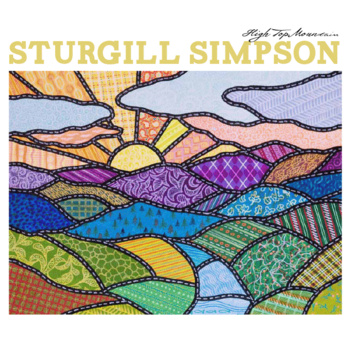
Sturgill Simpson High Top MountainSturgill Simpson’s High Top Mountain is just about as good as it ever gets. If I had made a list of the best albums of 2013, it would have been #2, behind only Jason Isbell’s Southeastern but beating Brandy Clark, Kacey Musgraves, and even Guy Clark. I bought my copy at a Simpson show in D.C. in November and haven’t looked back since.

I’m writing this review so late only to help me prep for my next review — Sturgill’s new 2014 release, Metamodern Sounds in Country Music. I’m going to quick hit each track one by one, but skip most overarching notes, other than to say this is a true outlaw record (even if he does sing “the most outlaw thing that I’ve ever done was give a good woman a ring”) – and not like the faux “new outlaws” like Eric Church. When I first heard Sturgill sing and his band play in that bbq joint basement, I said “Holy crap they sound just like Waylon,” and most other critics have said the same. But that’s really an unfair thing to say and I need to stop, because despite the similarities, Sturgill is his own singer and definitely his own writer. He writes great songs, and knows how to sing them with soul.

It’s the opening guitar blast of “Life Ain’t Fair and the World is Mean,” it’s the growling on “Sitting Here Without You,” it’s the pacing and chorus lyrics on “Some Days.” The emotional loneliness of heartache we’ve all felt that is captured so perfectly in several of these songs. The fast tempo and steel guitars of “You Can Have the Crown” are enthralling. References to Baghdad and the Internet that keep it fresh and relevant. And everything, just everything about “Water in a Well” and “Time after All.” Am I gushing? I’m gushing. I love this album, especially for a solo debut where the artist wrote all but two of the tracks.

As for those two tracks – holy cow he lets loose on Ralph Stanley’s “Poor Rambler!” The other is the closer, Steven Fromholz’s “I’d Have to Be Crazy,” where Sturgill’s voice is just about perfect. Fromholz unfortunately passed away this year in a tragic hunting accident, but I’m glad he got to hear his music honored this way first (though apparently he didn’t like it). It’s really unfair to compare either cover to its original (or to Willie Nelson’s version of “I’d Have to Be Crazy”) because the styles are just so incredibly different — but if pressed, I would prrrrrobably say I prefer Stanley’s “Poor Rambler” but Sturgill’s “I’d Have to Be Crazy.”

Other than the Stanley comparison, the only less-than-positive thing I’ll say about High Top Mountain, and it isn’t even negative, is that I’d love it if Sturgill would try his hand at writing and singing some ballads. That would really bring him back to the older feel he told his producer he wanted. “Old King Coal” and “Hero” both come close but don’t quite check that box. “Hero,” about Sturgill’s grandfather, is a helluva song that reminds me of my own amazing grandfather John Mascarella, the greatest man I’ve ever known, but other than verse two it’s still ultimately describing a great man rather than telling his story. (Don’t get me wrong, I love that song, I’m just saying, it doesn’t check the ballad box.)

Five whiskey bottles out of five – and note that the digital copy is $2 cheaper on Sturgill’s site than on iTunes. It’s independently produced, so buying direct from the artist matters.

“High Top Mountain” was produced by Dave Cobb at Falling Rock and Hillbilly Central, both in Nashville, for Sturgill’s own independent label, “High Top Mountain Records.” It features Hall of Fame session musician Hargus “Pig” Robbins (his first major recording was Jones’s “White Lightning”) on piano; Chris Powell on drums; Waylon Jennings guitarist Robby Turner and Leroy Powell on steel guitar, Turner and Brian “Freedom Eagle Bear” Allen on bass, Bobby “Diamond Bob” Emmett on organ and Mellotron, and Cobb on 12-string electric guitar.

Turns out the Westboro Baptists are not Brad Paisley Fans

It would seem the Westboro Baptist Hate Group has switched from “God Hates F***” to “God Hates Drunks.”

So Brad Paisley, whose song “Alcohol” just made #54 on Rolling Stone’s list of the 100 Greatest Country Songs of All Time, had a little fun.

SHOT

CHASER

According to the New York Daily News, Paisley “isn’t the first singer to be targeted by the extremist group. Westboro has staged protests against many musicians over the years, including Michael Jackson, Lady Gaga, The Foo Fighters, Taylor Swift, One Direction and Paisley’s fellow country singer Blake Shelton.” I love that while they called Shelton Paisley’s “fellow country singer,” they didn’t give the same label to Swift. That said, after “Boys ‘Round Here,” I’m not sure why Shelton gets the label, but I digress.

As another country reminder for Westboro:

Should country radio split into two formats?

According to Trigger over at Saving Country Music – perhaps the best blog in this space – “The Split of Top 40 Country & Classic Country Is Upon Us.”

Empsall at a George Strait Concert in 2007

The writer at a George Strait concert in 2007

Big Machine Label Group (BMLG) – the label for Reba, Taylor Swift, Florida Georgia Line, and many others – has signed a deal with Cumulus, the country’s second biggest radio conglomerate, to create a new format. They’ll launch stations that only play “classic” country artists from a 25-year period (likely 1989-2014, but I could also see something more like 1985-2010 to bring in more George Strait and Alabama and cut out all, not just future, hick-hop). This comes at the same that BMLG is looking to sign new legends like Garth Brooks and Alan Jackson and just after a station in Kentucky experimented with playing only Garth Brooks (and is now focused on ’90s hits, similar to the new Cumulus format).

This kind of a split would finally acknowledge that Florida Georgia Line and Luke Bryan aren’t even remotely the same genre of music as Trisha Yearwood or even Kenny Chesney. Pros for neo-traditional country fans: Finally the chance to hear “Blue Clear Sky” and “Fancy” on the radio more than twice a year again. Cons: BMLG CEO Scott Borchetta says the format would replace many of the current classic country stations, so all that extra Brooks & Dunn would actually come at the expense of what little Merle Haggard we currently get.

Do I think this split is a good idea? No, and not just because of what it means for country’s distant past. I’m also worried about what it means for the future of country music. Limiting a station format to only certain artists, rather than a certain sound, essentially enshrines that sound in history. It would basically ban any new artists with a neo-traditional sound from the airwaves – they would be neither hip-hoppy or poppy enough for one format nor old or established enough for the other.

That said, I am all for a split in country formats, just not this particular split. Base the split on sound, not time. Make it about the actual music, not a nostalgia for country “oldies.” Mix together all the different subgenres of country and even pop that draw on American roots – neo-traditional country, outlaw country, folk singer-songwriters, indie folk, newgrass – and let the hick-hop and country pop groups go off to do their lousy little thing. That would still accomplish Borchetta’s goal of bringing back Alan Jackson’s full catalog and playing the new stuff from older folks like Billy Joe Shaver, but it would also harness the power of the Avett Brothers to elevate lesser known acts (at least lesser known among the mainstream) like Sturgill Simpson, Nickel Creek, Kelly Willis, and Brandy Clark.

No, it’s not a perfect blend. I’m not pretending that Mumford & Sons and George Strait go together – but they go together a helluva lot better than Jerrod Niemann and Strait do. It may not be a great compromise, but it beats the one that’s been shoved down our throats these past few years, and it wouldn’t shut out newer roots voices like the new Cumulus plan would do.


‘Rolling Stone’ launches new country music website with greatest songs list

RS CountryWell now this is  interesting – Rolling Stone magazine launched a new venture today, “RS Country.” It’s a new Nashville office for the new rollingstonecountry.com, and the next print edition will be a special issue focused on country. According to editor Gus Wenner,

Now more than ever, music is all mixed up again. Listen to country radio today, and you’ll hear heavy-metal guitar solos, hip-hop rhythms and EDM flourishes alongside pedal steel and twang: Country now encompasses all of American pop, decked out in cowboy boots and filtered through Music Row. Listen to pop radio, in turn, and you might hear [Taylor] Swift, Carrie Underwood, Lady Antebellum or Florida Georgia Line.

Rolling Stone has always been about storytelling, as has country music – and we’re excited to have a new world of stories to tell. We will treat country the way we treat every other subject we cover: We will take it seriously, we will look beneath the surface, and we will always focus on what brought us here in the first place – the music.

The new website launches with a diverse set of articles covering all aspects of country – an interview with Keith Urban, reviews of the new albums from Sturgill Simpson and Nikki Lane (look for mine later this month or even week), and in true Rolling Stone fashion, their 100 Greatest Country Songs of All Time and a 10 New Artists You Need to Know: Summer 2014 that’s thankfully much heavier on the Americana than the hick-hop.

Both lists bode well for RS’s expanded country coverage. Unfortunately, the only way to read them is as a slideshow, and that’s just stupid. But I did the clicking for you, and here are their top 10 songs:

  • 10. Waylon Jennings and Willie Nelson, ‘Mammas, Don’t Let Your Babies Grow Up to Be Cowboys’ (1978)
  • 9. Dolly Parton, ‘Jolene’ (1973)
  • 8. Merle Haggard, ‘Mama Tried’ (1968)
  • 7. Ray Charles, ‘You Don’t Know Me’ (1962)
  • 6. Tammy Wynette, ‘Stand By Your Man’ (1968)
  • 5. Jimmie Rodgers, ‘Standing on the Corner (Blue Yodel #9)’ (1930)
  • 4. George Jones, ‘He Stopped Loving Her Today’ (1980)
  • 3. Hank Williams, ‘I’m So Lonesome I Could Cry’ (1949)
  • 2. Patsy Cline, ‘Crazy’ (1961)
  • 1. Johnny Cash, ‘I Walk the Line’ (1956)

Looking through the full 100, the ’90s are a little underrepresented – no “Check Yes or No” or “Should’ve Been a Cowboy”??? – but thank Heavens there’s absolutely no Luke Bryan in sight. In fact, after Taylor Swift’s “Mean” from 2010 clocks in at #24 (the hell?), there’s absolutely nothing from after 1987. I also love that Kacey Musgraves’ “Follow Your Arrow” from just last year is #39.

What do you think of Rolling Stone‘s list? Don’t see your favorite? Disagree that “All My Exes Live In Texas” is George Strait’s best? Upset he didn’t have anything higher than #18? Outraged “Goodbye Earl” beat “Golden Ring” or “Pancho and Lefty”? Let’s discuss in the comments below!

What country music needs is another Willie Nelson

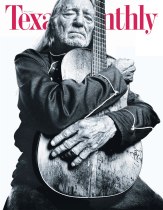
In a Texas Monthly cover article devoted to George Strait’s retirement from touring, Craig Havighurst argued that there may never be another George Strait.

George has been my favorite singer since I was 11, so I don’t say this lightly, but I would submit that what country and roots music need is not a new George Strait, but a new Willie Nelson.

Willie’s greatest accomplishment isn’t any one song or album, helping pioneer the outlaw sound, or even managing to make one beat-up old guitar last this long. It was the bringing together of diverse crowds that had always been at odds and finding among them common ground, new friendship, and a powerful movement. Like Bruce Robison sings,

“Like a miracle all those rednecks and hippies // From New York City down to Mississippi // Stood together and raised a brew // When it’s all gone wrong, what would Willie do?”

We need someonImagee to do that again – someone who can unite the red dirt cowboys, the Mumford hipsters and Lumineer moms, and the old singer-songwriter foagies.

Think about it. I went to a Nickel Creek concert earlier this month in Washington, D.C., and the audience was incredibly young – dare I say largely hipster. Now I’m not saying that that’s newgrass’s main demographic. It was the venue, the 9:30 Club, more than anything. Still, it was encouraging to see such a young crowd at a fundamentally bluegrass show.

And take indie folk, definitely a big draw for college students and hipsters. Personally I like Mumford and Sons, but I know a lot of folks find them insufferable. That’s fine, but love them or hate them, there’s no denying the influence folk and bluegrass had on their instrumentation and harmonies. Of course they’re not Americana, they’re British! But while Marcus Mumford, the Lumineers, and their ilk may be more of a response to pop than country, they are still our distant kin.

And yet, I would wager that the Mumford and Nickel Creek crowds of the east coast bear very little resemblance to a red dirt festival in Oklahoma or a Kacey Musgraves home crowd in Texas.

The question is, how can we elevate roots music and take back country music from hick-hop light beer bros? How can we build a coalition large enough to make the record labels take notice, the way they noticed George Strait in 1983 and turned away from Nashville easy listening to the neo-traditionalists? We need some way – someone – to unite the the subgenres and create a movement.

L-r: Drew Ball of the Riverbreaks, Sturgill Simpson, and the author, Nathan Empsall

L-R: Drew Ball of the Riverbreaks, Sturgill Simpson, and the author, Nathan Empsall

Maybe, just maybe, Sturgill Simpson will bring together the hipsters and cowboys the way Willie brought together the hippies and bikers. He’s a country traditionalist but one who’s not afraid to experiment, and after refusing to compromise with the major labels, his independent second album smashed through and debuted at #11 this month. Who are the crowds taking notice and driving that to the top? He comes from Kentucky coal country but has been featured on NPR; are those audiences coming together to give Metamodern Sounds in Country Music such a big boost? And will radio take notice?

I don’t know. But whether Sturgill is the next Willie or not, he’s at least a herald – if not the roots Messiah, then maybe our John the Baptist, proving that a better future is coming soon. That said, I don’t mean to put pressure or expectations on him; his art is already a breath of fresh air that speaks for itself. I’d say let’s just cross our fingers, but you can’t pick a guitar with crossed fingers. Instead, pour another round, play that Uncle Tupelo album one more time, and we’ll see what we see when we see.

UPDATE: After writing this post, I did some more reading, and found that Trigger over at Saving Country Music makes a similar arugment.

I still have hope for the future of country music

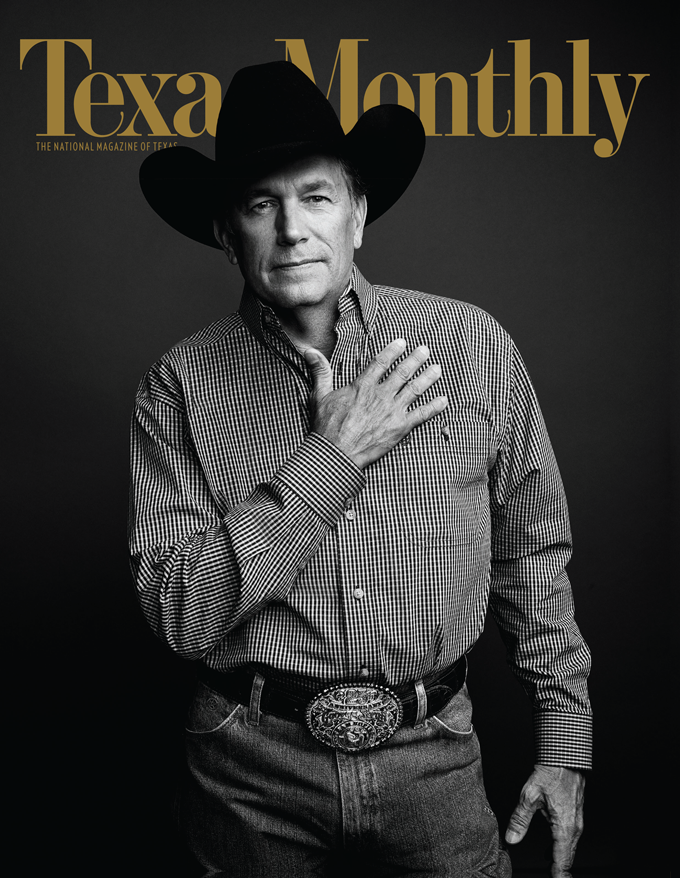
George_strait_texas_monthly_cover_no_typeTexas Monthly is always far more than a regional magazine, but this month’s cover is really something special. No words, no article teasers, just a black-and-white of the retiring (from touring) king George Strait with his hand on his heart, looking straight into the camera and straight at his fans. It’s direct, it’s simple, and it tells a personal story without needing any bells, whistles, or other distractions — just like George Strait himself.

Granted, I’m biased; Strait has been my favorite artist since I was 10, and I write this post wearing jeans from Wrangler’s George Strait line, literally the only kinds of jeans I own. But even allowing for all that, the two cover articles are both must-reads for any traditional country fan – one a retrospective of Strait’s career by TM’s always-excellent John Spong, the other an essay pondering the future of country music by Music City Roots’ Craig Havighurst.

These are dark times for country music, there’s no doubt about that – and sadly, Havighurst argues that there will probably never be another King George. “Were [Strait] starting out today, he’d face a quick-hit culture that would undoubtedly clash against his tempo and timing… Perhaps the system just doesn’t do built-to-last anymore.” (Well, one can only hope that Florida Georgia Line will have the longevity of an Ikea dresser.) Havighurst also points out that Brad Paisley’s momentum is slowing, Josh Turner hasn’t been nominated for a major award in six years, and Kacey Musgraves’ critical adoration “feels like a dark harbinger of how she’ll fare on the radio long-term.” It all reminds me of what singer Clay Walker said late last year:

Traditional country music died. I think that George Strait winning Entertainer of the Year at the CMAs was, to me, a symbolic and a real closing of the door… I think people are fooling themselves if they think for a second that the recording industry is going to accept any more traditional country music on the radio.

Maybe Havighurst and Walker are right, but I’m not so sure. Strait was a traditional singer who toppled slick, commercial music and forced Nashville to make room for a new kind of sound. The way he did it can’t be replicated, no, but perhaps the feat itself can still be accomplished another way.

In 1980, Strait’s traditional, Texas sound was almost as out of place on mainstream country radio as it is today. I don’t disagree that the way Strait broke through then would be almost impossible to replicate today. As Spong explains:

Back then, most radio stations were owned by individuals, and all [manager Erv] Woolsey had to do to get Strait on the air was get program directors to attend his concerts. Now those stations are owned by only a handful of conglomerates like Clear Channel and Cumulus, and the people at the top of those pyramids have decided to stick with this new sound. Sometimes country radio seems like one long, loud song.

What all that means is that in 1983, you could have thousands of chances to make it big in dozens of regional markets; today, you have just three or four chances in one national market.

As dire as that sounds, the future of country radio and record labels is NOT the same thing as the future of country music. In 1983, if you wanted to be a music star, you had to make it big on the radio. That’s still somewhat true today, but things are changing fast, and the market landscape will be radically different by 2020 or 2030.

Radio isn’t dying the same way newspapers are, no, but ratings are falling. It’s true, 92% of Americans listen to the radio each week versus just 20% who listen to Internet radio – but 20% is a huge number when you consider that Spotify is just four years old. Demographics matter, too – what’s the age of the average FM music listener? Today’s youth don’t want to roll the dice and hope the DJ plays something cool when they can just design their own iPhone playlists.

Similarly, while major record labels are still the only way to become a superstar, they don’t have the same stranglehold on middle-tier success that they used to. Thanks to Internet crowd-funding and social media, there are now dozens of ways to build a fan base. Nothing proves that more than this month’s stellar news that traditionalist Sturgill Simpson’s second album debuted at #11 on the charts – independently produced, a perfect bird to the major labels.

Are Internet radio, social media, and crowd-funding the future of pop music? And if so, does that extend to the demographics of a traditionally more-rural format like country? I don’t know. The tech landscape is changing too fast, and too much is at stake in the net neutrality battle, for anyone to authoritatively state that they know what Web 3.0 or 4.0 will look like. But what we can say is that the future does not look like the present.

The deep pockets always tajohnny-cash-fingerke over a genre once it starts to get popular – and the people always counter with something new. When pop became stale, along came rock. When rock became too slick, along came punk. When Nashville threw out the steel guitars, the Texas outlaws gave them the middle finger and the neo-traditionalists pulled Hank Williams’ old cowboy hat out of the dumpster. And today, with pop more obsessed with teenagers than ever, indie folk has come along with its banjos.

Giant corporations try to put profit before people, but there are always just enough people with just enough voice to scream “SOD OFF” loud enough to make it stick. So no, the record labels can’t be beat the same way they were in 1983. But they can be beat another way, and time will show us exactly what that is. Maybe Sturgill is already leading the way.

Brad Paisley, Bipartisan Patriot

It was big news when President Obama visited troops in Afghanistan this Memorial Day weekend to say thank you. It’s easy to forget that we are still a nation at war – the press and most politicians certainly don’t go out of their way to remind us. So anytime Afghanistan is put back in the news, as an activist and the older brother of an Afghanistan vet, I’m grateful.

In lesser but equally cool news, Brad Paisley, fresh off a great appearance on Prairie Home Companion, joined the president on Air Force One for the trip!

Brad Paisley is one of the few mainstream stars still singing real country – and apparently, he’s also a bipartisan patriot. Brad might have spent this weekend with the Democrat Obama, but earlier this year, he was busy teaching the first President Bush how to take a selfie: