In one, I dreamed that George Strait had an album called “Personal,” similar to Johnny Cash’s posthumous “Personal File” – different versions of his famous hits, covers of favorite songs, traditional gospel and folk classics, etc. One of the tracks I dreamed was on “Personal” was a stripped-down, slower version of his #1 hit, “Wrapped.” When I saw Wrapped’s songwriter, Bruce Robison, in concert earlier this year, he explained that the song was supposed to be a sad one – he’d written it at a point when he and his then-ex-gf now-wife were broken up and it was tearing him apart. But Strait made it sound like a happy upbeat song about just being in love. Robison said he likes the happy version more, but when I stop and read the lyrics thinking of it in the context of an ex rather than a current love, it makes a lot of sense as a sad song too, yearning for that one love you can’t escape: “It feels like ages since you laid down in my arms // I see no good reason but still I’m tangled in your charms // My God, you’re smilin’, you catch my eye // My heart is pounding deep inside.”
It’d be very interesting to hear Strait sing it that way.
My other dream was less country/roots, but still about music. I was sitting on the floor in front of a piano with eight pedals, kind of drunk, and discovered that I could play simple tunes with just the pedals. That was weird.
Earlier this week, I wrote a review of the new George Strait album, which was completely ruined by overuse of autotune (not as a T-Pain-style instrument, but turned up so high the voices didn’t sound human anymore). When I mentioned this, a friend wondered if maybe Strait is losing a step and needed the help to bolster his voice. No.
I’m sure this was justified in a loud, crowded arena to help the voices carry, but it was a terrible decision for a recording – and in response to my friend’s question, completely unnecessary. Check out this video I found from earlier this year of Strait picking up a guitar and singing a couple impromptu bars at a charity auction with no sound equipment – the voice is perfect!
I have never been as disappointed in an album as I am the live recording of George Strait’s final tour concert, “The Cowboy Rides Away.” Not because it’s a bad album, but because it should have been so much more. George Strait is the greatest recording artist I have ever heard, BAR F*ING NONE. The concert was amazing and both he and his fans deserve so much better than this travesty. I can’t believe I’m writing a bad album review for GEORGE FRIGGING STRAIT.
One word: G*D DAMNED AUTOTUNE. Okay, that’s two words. But listen, I’m in the process of becoming an ordained minister. I am not taking the Lord’s name in vain here – I’m simply literally asking the divine to DAMN THE MONSTROSITY THAT IS OVERUSED AUTOTUNE AND THE SIN THAT IS CALLING IT MUSIC. ENOUGH ALREADY.
Don’t get me wrong. From the clips I’ve watched, George Strait’s farewell concert was exactly what it needed to be, and we all know the legendary career. There is none greater in the history of country music and if you think Hank or Cash can beat it then just shut up because I’m a Texan and what I’m doing right now is called hero worship. I wish to high heaven I could have been in Dallas in June. But this God-awful album is chalk-full of autotune, and nothing else can shine through. You can hear it on most tracks, but especially on George’s voice on “The Cowboy Rides Away” and “I Can Still Make Cheyenne,” as well as Alan Jackson’s on “Murder On Music Row.” It even dominates the gorram fiddle on “Fool Hearted Memory.”
I can see how autotune would help the voices carry across a crowded arena of 104,000 screaming fans and I wish I’d been one of them – but recorded?
No, just, no.
There’s a reason Luke Bryan and Florida Georgia Line did not perform at the King’s last show. At least Jason Aldean pretended to be the old Jason, not the new Jason. This was a farewell salute to REAL country music. So what the hell was autotune doing so prominently on the album, even if it was necessary at the show? You can say it’s fine music, and you might not be wrong, but that don’t make it country.
This is not George Strait’s first foray into autotone. There were those couple lines in 2001’s “Stars on the Water“. But, that was one track on one album – I can’t blame anyone for experimentation. A mark of a true professional is trying, failing, recognizing it as failing, and moving on. And that’s what George Strait did, for 13 years – so I can only blame MCA for this bullshit.
King George’s next studio album – as he’s only retired from touring, not recording, and is already back at work in the studio – can’t come soon enough to wipe this bloodstain from our ears. In the meantime, just stick with 2003’s “For the Last Time: Live from the Astrodome“.
Two whiskey bottles out of five. The songs and singers are of course four or five bottles because it’s GEORGE STRAIT, but frick this should have been done better. This was clearly a fast turnaround by major-label execs who saw big dollar signs and wanted to make a quick buck – it has nothing to do with respecting fans paying homage to the best musical career in four decades. Money over music, everything Strait’s (admittedly poorly acted) movie strained against. No, just, no.
Ah, hell. At least it included the Martina McBride duet on the old Cash favorite, “Jackson.” That was a lot of fun when I saw the show in Philadelphia, so, that’s something.
Huge news for the best new name in country music: Zac Brown has asked Sturgill Simpson to open for two New Jersey shows on July 10 and 11!
I had planned to see Sturgill open for Pokey LaFarge in Virginia on July 10. But last week, I learned about ZBB’s invitation after Sturgill had to cancel the Virginia gig plus one in Boston on July 13. The news wasn’t public yet and the person who told me didn’t realize I was a blogger, so I waited to post it. But, though no one seems to have reported it yet, it’s officially on ZBB’s site now!
This is Sturgill’s biggest break yet, far bigger than opening for Dwight Yoakam last year. No, New Jersey isn’t exactly a hotbed of country music, but opening for an act as big as Zac Brown will give Sturgill some attention and credibility with a crowd that may not usually pay attention to NPR, the New York Times, or even Rolling Stone – sites that helped propel his second solo, independently produced album to a #11 debut.
If anyone in the country industry was going to give traditionalist Stugill a hand up, it makes since that it would be Brown. He took the bro-country bull by the horns last year when he publicly called Luke Bryan’s “That’s My Kind of Night” “the worst song I’ve ever head.” No, Brown’s music isn’t exactly country, but I don’t say that as a criticism. It’s still roots music — Southern rock, and Brown is the first to call it that rather than country — and if you get past the beach-living singles, his first two albums were really good stuff. If I’m in the car for more than two hours, I’m playing “You Get What You Give” — I call it my roadtrip fuel. If there’s any major mainstream-country concert crowd that will appreciate Sturgill, it’s probably Brown’s. If nothing else, it will certainly help him get noticed by the entertainment reporters who cover Brown.
It’s particularly good news for country music, since it comes shortly before Brandy Clark goes on tour with star Erich Church this fall. Church might be a real asshole and his music isn’t perfect, but it is some of the best on “country” radio right now. Obviously we can’t expect Luke Bryan or Florida Georgia Line fans to hear a new, true country act and suddenly love it, but Church or ZBB crowds just might – and again, there’s the entertainment press that covers them.
I have every intention of driving up to New Jersey for the show, and will of course review it here. You know what Sturgill opening for ZBB kind of reminds me of a little bit is George Strait’s big break. In 1983, Eddie Rabbit got sick and had to cancel a performance at the Houston Livestock Show and Rodeo. Strait, just off his first #1 hit, was called in as a last-minute replacement – and 31 years, 20 more Houston rodeos, and 59 more #1 hits later, he’s finally retiring from touring. It broke my heart to miss his final show down in Dallas – but maybe, just maybe, I’ll get to watch a new legend take off the very same summer another one wrapped things up.
Less than a year after their last album, “Cheater’s Game” (one of 2013’s best), Texas country husband/wife team Bruce Robison and Kelly Willis have put out a new one, “Our Year.” Their sound is certainly more traditional, and their lyrics deeper, than anything on the radio today.
I really like this album – and I loved seeing them in concert last week at Alexandria, VA,’s Birchmere (with Dale Watson as the opener, but I’ll review both concerts in a forthcoming post). I will say that I think I liked last year’s “Cheater’s Game” a little more. It feels a little like the duo came up with 23 amazing songs and picked the 13 best for an album, but then realized the remaining 10 were still strong enough for another project. Sometimes that doesn’t turn out too well – see Springsteen’s “Magic” followed by “Working on a Dream” – but in this case, it’s not a bad thing at all. If “Cheater’s Game”‘s larger shadow were to disappear, “Our Year” would stand very well on its own.
Overall, the voices are great, and it’s a solid balance between uptempo and melancholy. The only thing that holds it back is that it’s a little softer than “Cheater’s Game” – there’s nothing adventurous here. It’s comfortable, maybe even safe. But sometimes, that’s okay. Towards the end of last week’s show in Virginia, Robison told the crowd that they’d thrown a lot of new stuff at us that night which is always risky, but we’d seemed to take it well. Yes, Bruce, we did – and there’s no need to apologize at all. It’s new stuff, but it’s good stuff.
I’ll come back to the album in a moment. First, some context. Willis has one of the absolute best voices in country music and Robison is one of the better songwriters. He penned the #1 hits “Wrapped for George Strait (I’ll write a separate post later about that song’s origin story, it was great), “Travelin’ Soldier” for the Dixie Chicks, and “Angry All the Time” for Tim McGraw and Faith Hill (I like Robison’s rendition better – he does sad well), as well as Strait’s #6 “Desperately.” As for Willis, she had a few songs chart in the early ’90s, though unfortunately none reached the top 40s. I’m personally most familiar with 1993’s #72 “Whatever Way the Wind Blows.” My mom had a now out-of-print compilation CD of Texas country that included that song and was also my introduction to Bob Wills. When I saw recently that Willis had sung it, I thought it was a cover, until I listened again – “No, this is it!!! How was that only #72, I thought it was a huge hit????” Nope, my mom just played that album a lot. And decades later, I’m still better off for it.
Back to the album. “Our Year” is relatively stripped down yet still well-produced. The smaller, rootsier instrumental feel, more than the relatively light tough of the steel guitars or fiddles, is what makes it Texas country. Willis’ music has lost the commercial sheen it used to have, making it even better than it already was, and Robison is very down to earth, as well as a smoother tenor than you usually hear in country.
It’s a mix of covers and new originals. The first track is “Departing Louisiana” by Robison’s sister Robyn Ludwick. Thematically, it reminds me of a slower version of Mac Davis’ “Texas in My Rear View Mirror.” It’s probably my third favorite track on the album, after two Robison originals. It leads into Walter Hyatt’s “Motor City Man,” a rock-influenced but fiddle-strong peppier salute to a better life that Willis does wonders with.
Bruce Robison and Kelly Willis at the Birchmere in Alexandria, VA, 06-06-14
Track three, “Carousel,” is a Robison original about how hard relationships are, and it’s probably the best song on the album (though “Anywhere but Here” is a close runner-up). It’s got a great melody and uses the steel guitar very effectively for a sad feel. “There comes a time the music has to stop, it’s the end of the ride… But people love a carousel, and no one is to blame.” Even though Willis’ voice is the album’s real star, this showcases Robison’s quite well.
That leads to a Willis original, “Lonely for You.” This is a really interesting one to hear a husband and wife sing together – it’s a song about missing an ex. Several of the next-up songs are similar in that regard, too — but it sounds great and it’s well written. That leads to a lover’s duet, “A Hanging On,” that’s been covered many times, but sounds great here too. Next up, before he was a legendary producer, T-Bone Burnett wrote “Shake Yourself Loose” in 1986. There’s nothing new about this sound, but the couple trade verses and their voices are perfect.
You know the next one – a cover of Tom T. Hall’s classic “Harper Valley Pta.” In concert, Robison said this was one of those pairings where the song and the voice (Willis’) seem perfect for each other. Indeed, they’ve apparently been playing it in concert long before recording it, and he’s definitely not wrong. Her vocals are great here. But I’ll also say this – it’s disturbing how much this song, a social critique, feels like it could have been written in 2014, not 1968. It can seem like there’s as much sexism and hypocrisy today as ever.
“Anywhere But Here” is another Robison original and another of the album’s highlights. The melody here is great, and Robison sure writes good choruses. This is about the fading memories of yesterdays gone by and a present that’s only getting harder. “But now it’s only stars and shadows, and heaven’s just a dream // I thought that I knew trouble, but the devil laughed at me // Any life that was worth living, any moment without fear // It’s getting harder to remember anywhere… but here.” It’s a great pairing of lyrics and melody. Since Nashville foolishly seems intent on seeing Robison as just a songwriter, I hope a star picks this song up and slows it down just a little. I could see it being a potential melancholy hit for a voice like Gary Allan’s.
The album closes with Don Reid’s “I’ll Go to My Grave Loving You” and the title track, “This Will Be Our Year,” by Chris White. The former is a nice uptempo tune to balance out the sadder “Anywhere,” and their voices blend together beautifully on the final, title track. Both are good covers, and a very fitting closer for a husband/wife duo who are riding success high and, as anyone in the audience can see, are clearly still in love.
3.5 whiskey bottles out of 5 for “Our Year”, but I’ll admit I might be letting “Cheater’s Game” – a 4.5 – influence me too much. Maybe “Our Year” actually deserves a 4. It really is a good album and I do recommend it.
There aren’t many good YouTube clips of “Our Year” material featuring both singers – so here’s a good duet one from “Cheater’s Game”, then a solo from “Our Year.”
Brad Paisley’s music is about as traditional as today’s mainstream country radio gets – he even used to feature George Jones! – so it was troubling to read last month that the new album will feature dubstep and be EDM-inspired. But you know, he did promote it on Prairie Home Companion of all places, and the lousy sound could be limited to just a track or two. It could even just be hyped. So I took a wait-and-see approach – the album’s not even out yet; let’s ignore the rumors and just wait to judge it on its own merits.
But then I read this in this week’s country issue of Rolling Stone:
Think Van Halen in a 10-gallon hat. “I couldn’t have done that in 1989,” Paisley says. But with country borrowing more and more from classic rock, “that kind of playing fits our format now,” he says. “It all becomes country eventually, somehow.”
It all becomes country? NO! Maybe it all becomes country radio, but that doesn’t mean it becomes country. The sound is the sound and country is country – you can’t just relabel the rest!
I love that Paisley’s guitar is taking centerstage with his voice more and more. But can’t it stay country guitar? Or at the very least, do we still have to call it country once it isn’t?
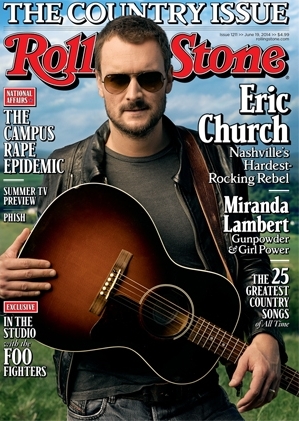
I wouldn’t call myself an Eric Church fan. I don’t change the station when his music comes on. Most of his stuff is middling, but every now and then he does a great song. It’s more rock than country, but at least it’s closer to rock than it is pop or rap, unlike most of of today’s radio. And since Church only puts an album out every three years and wrote 120+ songs for the new one, I do believe he’s in it for the music. Best yet, in the cover article for this week’s country issue of Rolling Stone, he praises Kacey Musgraves, rightly says “Brandy Clark should be the face of the genre,” and criticizes laundry-list bro-country as “shallow”. Bravo!
But on the giant other hand, Church is an arrogant jerk who glorifies and encourages violence, hypocritically performs with and thus enables some of the very acts he calls “shallow,” and insists he’s an “outsider” despite his industry awards, giant label, and huge sales. That’s either the biggest case of self-delusion the world has seen since Harold Camping, or just pure marketing crapola.
But my real issue is that Eric Church doesn’t respect country music or even understand what real country music is – to the point that he says that, like Santa or the Tooth Fairy, it doesn’t exist. From the RS story:
You can’t really put Bruce [Springsteen] in a box – what kind of music does Bruce do?” says Church. “It could be country. If he came out right now? No doubt, that’s where he’d live.”
Church’s music, on the other hand, could easily have been considered rock in the Eighties and Nineties… “True red-white-blue American rock & roll fans have gone more toward country. Hip-hop has gone down. Rocks’ down. People are kidding themselves if they think there’s a bigger format than country.”
“What kind of music does Springsteen do”? What a stupid question! ROCK! The answer is ROCK! Right in the middle of his own show, he’ll proclaim the concert “a rock and roll exorcism!”
Then Church says that “country” is now the biggest genre. Well, yeah, and if you want to change Alaska’s name to “Alabama,” then we could call Alabama the biggest state in the country. Which is exactly what Church is doing when he says “Born to Run” is rock if it’s the ’80s but country if its the 2010s. NO! It’s the same recording in any time, so it’s the same genre in any time! Nor is the country audience truly growing – the labels and radio conglomerates are just appealing to various portions of the pop, rock, rap, and country lite crowds all at once. It’s a bigger audience than country has, sure – the same way New York has a bigger population than Chicago. Moving from one to the other didn’t mean the city grew; you changed cities!
This “country” format Church says is so big is NOT country. It’s rap, pop, and rock thrown into a blender with a dash of banjo to mask the lack of twang and story. Simply calling it “country” is not enough to make it country.
But Church disagrees – he seems pretty adamant that rock and country are now the same thing. Last year, he told ABC, “Genres are dead. There’s good music. There’s bad music. And I think the cool thing about Nashville is it is at the epicenter of that kind of thinking.” An odd quote for a guy who says Brandy Clark should be the face of the “genre” – and complete horse hockey. To say there’s nothing more to it than bad vs. good music is to demand that we all have the same taste, to declare that if you like country then you’d damn well better like pop and rap, too, because you’re not allowed to have one without the other anymore.
This homogenization is a terrible thing. It is the true straitjacket on country innovation, and it is an attack on the diversity of fans’ tastes.
I know that a lot of people hate “labels.” They feel like you’re putting them in a box and taking away their individuality, especially in music – plenty of artists claim their music transcends genres and labels.
I understand and respect genre hopping. I do. But I also think labels can be a good thing. If I ask for chicken for dinner, don’t tell me, “There’s good food and there’s bad food, pull something out of the good bad!” No, dammit, this bag is labeled “Cheetos” and that bag “chicken” for a reason. Neither iTunes nor the last few record stores actually remaining are going to merge everything into two sections called “Good Music” and “Bad Music,” and it would be too overwhelming to have just one section alphabetizing EVERYthing. Broad labels are not a bad thing – they help us narrow things down, and give our searches somewhere to start.
Switching gears just a little bit, the RS article goes on to quote publisher Arthur Buenahora saying, “With Eric, we don’t need fuckin’ twin fiddles” – as if fiddles are a bad thing! Sure, you don’t NEED them to do country, but why is that supposed to be a laudatory goal rather than just something different?
The same giant, fiddle-appreciating audience that existed for George Strait in the ’80s, Alan Jackson in the ’90s, and Brad Paisley in the ’00s still exists today. It was only four years ago that Easton Corbin had back-to-back #1 hits! No, that audience’s taste hasn’t changed; it’s just that the music industry is ignoring that audience for a new one. It’s not about the music — it’s about the greed, the money, the bigger and bigger profits. So the next time Church defends homogenization, he should think about where that homogenization is coming from, and remember his own quote, “Once your career becomes about something other than the music, then that’s what it is. I’ll never make that mistake.”
George Strait is, without a doubt in my mind, the absolute greatest country artist who has EVER lived. 60 #1 hits without every giving up the cowboy image or neo-traditional sound. He’s been my favorite artist for nearly 2/3 of my life, and I have been blessed enough to see him four times live. I would have killed, literally killed, to be at last night’s George Strait concert in Arlington, Texas. I almost went, too – even just six days ago I still didn’t know I was going to do, but in the end, couldn’t quite swing it.
I knew I would absolutely lose it during the final “The Cowboy Rides Away” if I made it in person. But I didn’t expect to lose it just watching the clip on my laptop.
I should have gone to Dallas. I should have thrown every last bit of caution to the wind and gone to Dallas. And yet, he’s only retired from TOURing, not PERFORMing… he promises a few more one-off shows are still to come… my best guess is that that means some San Antonio area concerts and a few more shows at the Houston Livestock Show & Rodeo… something tells me I’ll get to the see king once or twice more yet, the good Lord willin’ and the creek don’t rise.
(If you must, you can skip to my actual rating and summary at the end of this post, but whatever you do, buy this album – buy it now. And remember, it’s independently produced, so you’re not giving your money to a rich fat label.)
Yesterday, two weeks after his second solo, independent album debuted at #11 on the Billboard country charts, a Rolling Stone Country headline asked, “Is Sturgill Simpson Country Music’s Savior?”
I wouldn’t use the word savior. Country radio could use a savior, but there’s lots good in country music that doesn’t need saving. That said, I did write last week that what country needs is not a new George Strait but a new Willie Nelson, and that maybe Sturgill would fill that role. That is, someone who can unite the many roots subgenres, create a movement, and eventually push it into the mainstream.
Trigger over at Saving Country Music, who does call for a “savior,” throws some cool water on all that for now. He loves Simpson – his 2013 co-artist of the year – as much as I do, but cautions against the danger of high expectations:
In the long run, for an artist like Sturgill to reach the CMA level, a lot of specific watermarks must be reached, and it’s imperative on his fans, and Sturgill himself, not to set unrealistic expectations that can end up deflating the positive momentum he’s created… Sturgill Simpson is purely country. This means hypothetically that the sky is the limit, unlike with Americana. But the CMA, and especially the ACM are set up to promote the country music industry… Sturgill Simpson isn’t part of that industry.
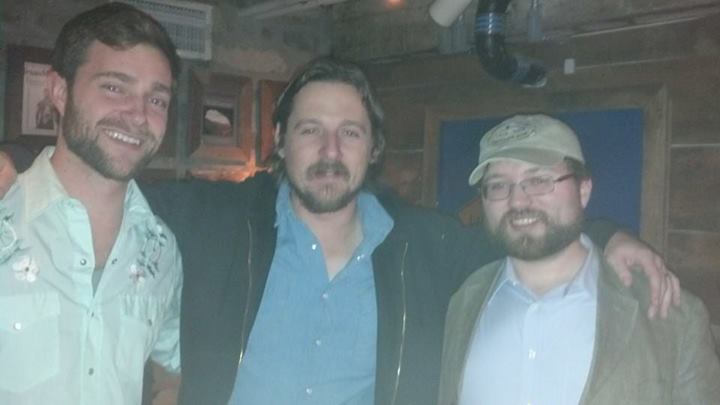
L-R Drew Ball of the Riverbreaks, Sturgill Simpson, and the writer, Nathan Empsall, in November 2013.
Fair enough. All that said, in every interview Sturgill gives, he seems to be filled with humility and focused more on his own identity, mission, and family than on professional success. “I’m not pursuing a mainstream career,” he told Billboard, “so I feel that I have the freedom to make the kind of records I want to. That’s a good feeling.” To CMT: “I could go back to the railroad. I liked that job.” And to NPR, “To be cliché and incredibly trite about it, I wanna make art… There was a big part of me that wondered maybe if this would be the end of my career. But you can’t worry about those things… A commercial path isn’t something I’m at all interested in pursuing.” And pretty definitively to Rolling Stone:
A lot of journalists, it feels like they want to lure me into being the poster boy, and talk shit about modern country, and I just don’t have anything to really offer there. Because, fortunately, I’ve never pursued that side of the industry, which means I never had the opportunity to be screwed over or have any of these horror stories that you hear about. So for me to sit and talk about that stuff would be insulting to people who have, and extremely naïve… I don’t know where I fit in, but I do know that when I figure it out, it ain’t going to be because somebody else did it for me.
Ok, ok. Let’s give the man some respect, and turn to the music itself.
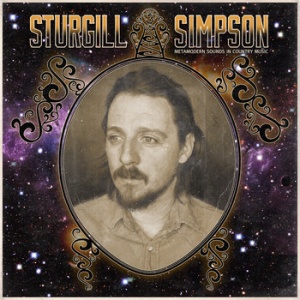
An Album Review: Metamodern Sounds in Country Music
This is not one of the greatest country albums of ALL time, but it is one of the greatest country albums in a long time.
Sturgill’s previous album, High Top Mountain, had an outlaw sound and a big focus on heartache and life’s struggles. Metamodern is no repeat. It generally keeps a similar sound despite a new band, but the lyrical heartache is mostly replaced with… well, with just about everything else, from black coffee to Buddha and reptile aliens, all of it driving at a bigger point about using love and compassion to get through life.
Sturgill says the album’s biggest influences were 80% his past experiences but also “The Phenomenon of Man by Pierre Teilhard de Chardin, and an essay that Emerson wrote called Nature… and then another book by Dr. Rick Strassman called The Spirit Molecule.” Or as he told NPR, it’s his “hobbyist interests… [in] the disguise of a traditional modern country record.” The liner notes also thank Stephen Hawking, Aldous Huxley, and Carl Sagan, and I think that last one’s especially cool because my birthday gift to myself this year was Sagan’s original “Cosmos” on DVD.
And yet, it stays country the whole time, both in its sound – traditional country – and its message, one of love and finding your way in the world. Astrophysics aside, Sturgill, who’s expecting his first child, says the album’s main point is really just the saving power of love for one another – and it shows. “Anytime I ever have met someone that was very angry or full of negativity, nine times out of ten if you really take a good look at that person’s life, there’s probably not a whole lot of love going on there.” Damn straight.
Before going track by track, I will say this: With Metamodern, Sturgill Simpson manages to simultaneously experiment AND keep sight of his roots. Eric Church, Luke Bryan, Jerrod Niemann, and the stations that play them should take notes. Bro-country, EDM, and pop stars like Church defend their music by saying stuff like, “If we’re making the same music as Waylon Jennings, Johnny Cash and Hank Williams, why not just listen to that? They didn’t do the music before them, they completely changed.” Well, no, the outlaws didn’t COMPLETELY change – they were experimental, yes, but they kept to their roots. The whole point was to remind Nashville of steel guitars, fiddles, and personal stories, and push back against the era’s poppy homogenization. The problem with the music Church and his crowd are creating is that they “experiment” by merging genres, completely losing sight of their roots.
Sturgill shows them all how country experimentation is done. Let’s take it track by track.
1. Turtles All The Way Down
Metamodern’s opening track has gotten a lot of attention, and for good reason. How many other country songs can you think of that are named for Hindu theology or a Stephen Hawking quote? “Turtles All the Way Down” has the most interesting blend of metaphysical, cosmic, and psychadelic lyrics you may ever hear in country music, with the bottom line that for all the fancy religious theories out there, simple love is the most powerful. The first words on the album are “I’ve seen Jesus play with flames in a lake of fire,” and soon after comes the now-famous line “There’s a gateway in our minds that leads somewhere out there far beyond this plane // where reptile alien made of light cut you open and pull out all your pain.”
But really, this song isn’t about cosmology, and it’s not about space aliens, either. That line is just a spacey way of talking about relief, about having our pain taken away. And what is that takes it away? “Marijuana, LSD, Psilocybin, and DMT, they all changed the way I see // But love’s the only thing that ever saved my life.”
I actually don’t appreciate the swipes Sturgill takes at faith. Yes, belief and religion have caused a lot of pain an destruction, there’s no doubt about that. But let’s not mix up Christ for the Christians – faith can also be the source of the very love Sturgill sings about and encourages us to seek. Like retired Episcopal Bishop Gene Robinson, known to most for being the gay bishop but he’s much more than that, says, “Show me the God you don’t believe in – I probably don’t believe in him either.” In fact, when no other person is around to love us, God’s love is still there. And that’s all I’ll say about that, because the underlying message of love is still spot-on.
2. Life of Sin, 3. Living the Dream
Track two, “Life of Sin,” pats us on the back for getting through Turtles. It’s much more what you’d expect from a stereotypical old country album, singing about how his songs come from a heartbreak and drinking himself silly. Next up is “Living the Dream,” the album’s first single. This one’s a bit more convuluted in its metaphysical meaning. I could pontificate but it would sound more like disagreement then reflection if I put it in writing – which is to say, I did put it in writing, but cut it in the editing. Better to just quote the NPR interview again: “I’m learning the less I talk about it, the more opportunity I leave for people to form their own interpretation. ”
4. Voices, 5. Long White Line
“Voices” might have the most poetic lyrics on the whole album. Sturgill writes about the voices pressing in on him, how they’re singing about society’s depression – “the rivers are crying but the oceans cannot speak.” He wishes they’d go away but they never will, and it’s not a sign of the end times because they’ve always been there. Yeah, this sounds like something an Appalachian man would know and should write. Next is “Long White Line,” which like Life of Sin after Turtles, pulls it back to traditional country themes, allowing us to towel off after such a deep dive – his girl’s gone, so he’s hitting the open road. The guitar’s rhythm is something right out of a Cash or Willie album, too.
6. The Promise
The album’s back half then begins with a cover of When In Rome’s “The Promise” from 1988, which starts as the slowest love song of either of Sturgill’s albums, but opens up to a little bit of very effective and appropriate Waylon-esque wailing toward the end. The lyrics, some of the very few that aren’t original, are a beautiful promise to always be there, to be supportive. I don’t care for new wave music but in Sturgill’s style, I see that I love this song. I will offer a slight negative note about the instrumentation though – the mellotron is just a little too sappy. The lyrics really hold their own on this one with the way Sturgill sings them, no need to try and make it more romantic.
7. A Little Light
On “A Little Light,” Sturgill’s vocals are more reminiscent of Randy Travis’s Gospel stint or even George Jones than of the usual Waylon comparisons. It has the feel of a a Gospel song, but the lyrics are a bit broader than just Christianity. Sturgill sings about walking the road to Heaven, but says all you need to get there isn’t a compass or a map but a little light inside you. It’s about love and light within, and I dig it.
8. Just Let Go
I love the first line of “Just Let Go”: “Woke up today and decided to kill my ego // It ain’t ever done me no good no how.” And this line, oh this line: “You have to let go so the soul can fall.” It’s true, like pastor and author Rob Bell says, if your hands are too full of the good, there’s no room left for the great, you gotta set it down. And the uplifting melody and high notes really fit the words. I might have toned down the slide guitar though – oddly enough, it reminded me a little too much of the Finding Forrester soundtrack, which I dig, but in a very different way. That music is more searching, whereas the overarching feeling here is almost like taking a divine bath in God’s refreshing and hydrating light, feeling the relief and love it brings.
9. It Ain’t All Flowers
Then we get to “It Ain’t All Flowers,” and this is where I go, “What the F***?” Lyrically, like so much else, it’s great. It’s about searching the corners of one’s own mind to figure stuff out. Sturgill alternates between howling and almost growling. It works well. But then they play the song backwards, and it switches from dark, psychedelic country — but still country — to something more urban, almost funk with a spooky edge.
I don’t like it, because it’s not me. And that’s completely okay, because this one isn’t supposed to be me. It’s supposed to be Sturgill. If you want to respect a song about plumbing the depths of one’s own mind, then you have to let the writer go wherever that takes him or you’re a hypocrite. And like Sturgill told NPR, this one “stands to represent my own introspective journey I’ve taken over the last few years.” I also like part of his goal here – the means were cool regardless of the ends: “Dave [Cobb, producer and engineer] had the idea: Instead of bringing in synthesizers, why don’t we just attempt to try to recreate some of [popular modern electronica] sounds using analog equipment? Which sounded amazingly fun and challenging, so we were all for it.”
10. Panbowl
We close with the hidden “bonus” tenth track, “Panbowl.” For the third time, Sturgill tells us, “Wow, alright, took you down a pretty weird path there, didn’t I? Here, let’s have a rest together.” It’s acoustic country influenced by his previous bluegrass career. It’s also a more relaxing song, opening with happy guitar chords. The subject is nostalgia for his Kentucky childhood, and love for his family. That kind of specific love and the stories that back it up are a natural conclusion to the rest of the album’s lyrics, and the acoustic sound helps balance things out. It really is the perfect end to the album.
No matter how weird this album gets, and even without a fiddle, it’s still a country album. This is an album with slide guitars about life, and what else is true country music ever about, really? Whether it’s complex, twisted, and psychological or just simple and emotional, laying your soul bare is still laying your soul bare. Pain is pain and the need for love is the same, no matter how it was we came to see it.
And this is why I say that Sturgill might, just might, be our next Willie Nelson. Metamodern’s foundational sound is what traditional and outlaw country fans look for. It’s experimental and electric enough that Americana and alt-country fans can dig it. Throw in just a few more lighter notes or acoustic sound on even just one track, and you may not appeal to the Lumineers’ indie folk crowd but it won’t keep them away anymore, either. We’ll see what fans do with Sturgill’s stuff over the next few years, but he certainly has the right kind of appeal to be the Willie-esque uniter that roots music needs to punch back against hick-hop.
I’d worry that saying stuff like that puts too much pressure on Sturgill from fans, except for two reasons. First, his last album said, “Life ain’t fair and the world is mean.” Second, maybe he’s not our Willie Nelson. Maybe he’s our Jackie Robinson – like Branch Rickey saw in Robinson, you’re not necessarily the best at the game, but you’re the best at taking the pressure. Like Sturgill told Billboard, “If it’s all good and it’s smoke being blown up your ass, and you start investing faith in it all, that’s a good way for you to set yourself up for a long hard fall. We’re just trying to keep moving forward.”
The Takeaway
4.5 whiskey bottles out of 5. I actually originally gave it five out of five for the first 8 hours this post was up, and should probably just leave it there, but something is holding me back. Objectively, this is a much better record than High Top Mountain, which I gave a 5. It’s absolutely a work of creative genius. And like I say, except for “It Ain’t All Flowers” (which I still respect), I love the sound. Sturgill hits the perfect spot of balancing experimentation with his roots. It’s also a big break from the subject material of his first album, showing great range and talent. Making this took a lot of bravery.
But personally, I prefer HTM, just out of personal taste, and feel like my ratings should reflect that. I also feel like something is dampening the sound. Trigger at Saving Country Music said it’s the recording hiss. Maybe. I think it also needs just a little more acoustic instrumentation, maybe some light fiddle, to open up the sound a bit – perhaps in place of the mellotron on The Promise. Not much, just a touch.
Finally, it’s exhausting. The tricks, the nuances, the metaphysics – it really makes you pause and think. You just can’t be neutral about this stuff. In fact, it reminds me a teeny bit of the debut of Beethoven’s Fifth Symphony. Today the Fifth is seen as an innovative masterpiece, but at the time, there was so much new in it that Beethoven’s audience was just confused. I dig this album, and its message of love is spot-on, but it wipes me out – as any country exploration of the soul should.
So yeah, 4.5, maybe even all 5, whiskey bottles out of 5, but also with the hangover that that much whiskey brings.
Metamodern Sounds in Country Music, like Sturgill’s previous record, was recorded in Nashville and produced by Dave Cobb. Except for Cobb, though, the band is all new: Laur Joamets on guitar, Kevin Black on bass, Miles Miller on percussion & backing vocals, Mike Webb on keyboards & mellotron, and Cobb on classical guitar & percussion.




 Top Mountain
 Hard Times No More